

domo.health and Duchenne Schweiz bring trusted answers to families with AI
Developed with Duchenne Schweiz and the University of Lucerne, domo.health's Knowledge AI Agent turns the association's expertise and Swiss support resources into clear answers, in four languages, by text or by voice.
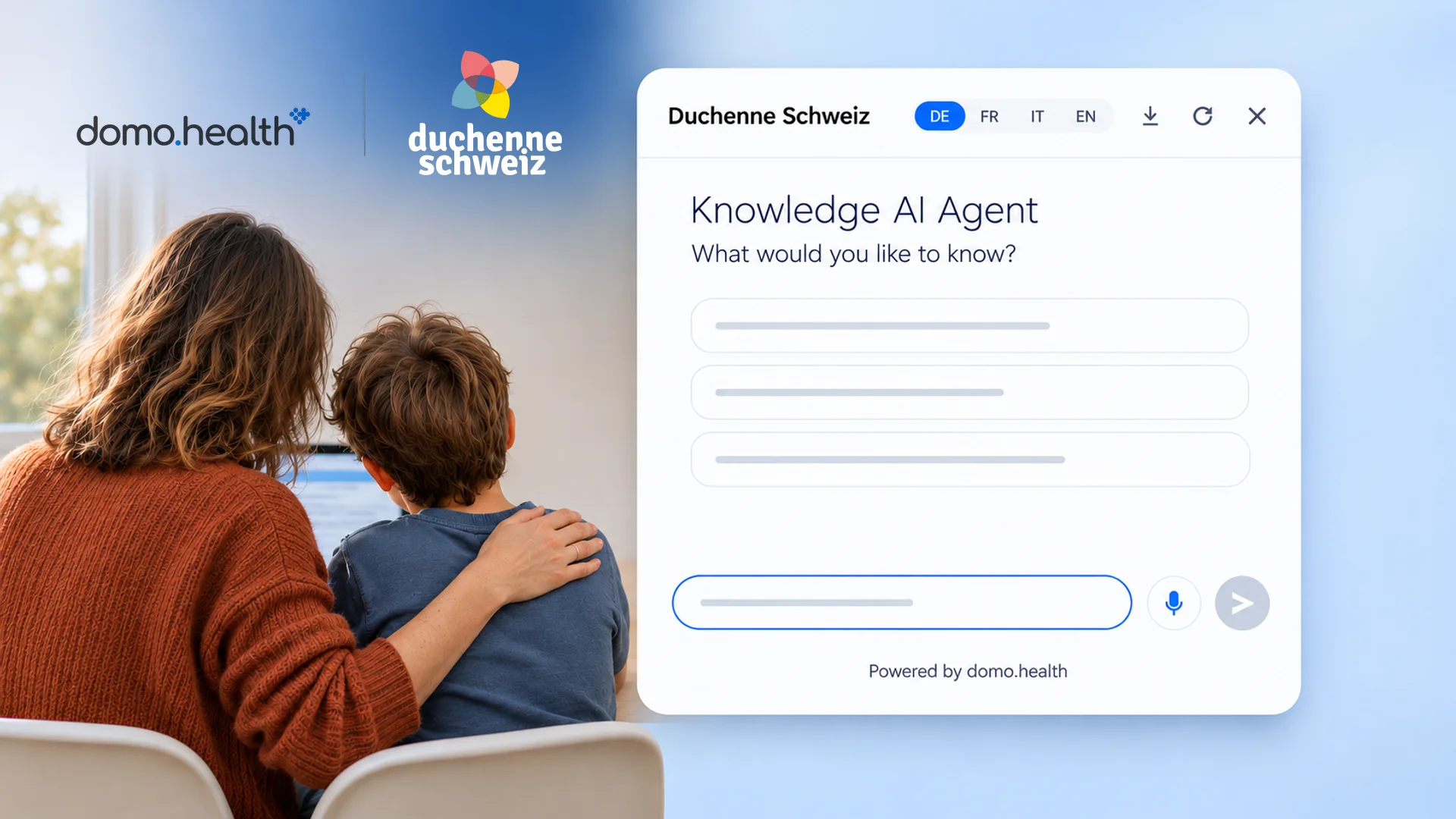
Lausanne / Lucerne, Switzerland, 10 November 2026. domo.health announces its collaboration with Duchenne Schweiz and the University of Lucerne to help families navigate life with Duchenne muscular dystrophy. Developed by domo.health and available on the association’s website, the Knowledge AI Agent answers questions about the condition, school, insurance, rights and support in Switzerland.
Visitors can type their question or simply ask it out loud, which helps people whose hand strength is limited by the disease. The agent answers in German, French, Italian and English. Separate modes serve families and professionals, and a conversation can be downloaded with its sources to bring to the next appointment.
For a family preparing for school, applying for assistance or planning the transition to adulthood, useful information is spread across many sources and areas of expertise. The agent draws on content curated by Duchenne Schweiz, Swiss legal and support resources. It finds what is relevant to each question, explains it in plain language and shows its sources.
Dr. Oliver Grübner, President of Duchenne Schweiz and senior lecturer and researcher at the University of Lucerne, Faculty of Health Sciences and Medicine, introduced the agent to families at the launch in Lucerne. "A diagnosis changes a family's life, and the questions keep coming long after the appointment ends. We wanted to make the knowledge of our community and the wider scientific and support network easier to access. We chose domo.health for its ability to bring healthcare expertise, AI and practical implementation together around the needs of families. For us, this is also about decisively improving the care structure at the Children's Hospital of Central Switzerland for integrative healthcare".
The collaboration builds on four workshops in 2025–2026 involving approximately 100 participants, including families, clinicians and researchers. The findings and agent’s design are detailed in an article submitted for publication by Oliver Grübner and 14 co-authors, with affiliations including Lucerne, Zurich and Maryland universities, Harvard Medical School, Loughborough University, the Children’s Hospital of Central Switzerland and domo.health. Within the FAMILY-NMD project in Lucerne, a pilot study will now evaluate the agent's usability, safety and value for families in daily life.
Duchenne Schweiz entrusted domo.health with developing and deploying the agent. Already working with 200+ organisations across homecare, clinical care and the pharmaceutical sector, domo.health combines healthcare AI with experience building and operating SaaS platforms, including domo.health PRO, and a research track record spanning more than ten years, 15 clinical studies and over 30 scientific publications.
"A family with a question about school support at ten in the evening deserves an answer they can check. The agent shows where its answers come from, and when its sources don't cover a question, it says so and points to Duchenne Schweiz instead of guessing. That is what trustworthy AI in healthcare looks like in daily life," says Dr Charles-Edouard Bardyn, Chief AI Officer at domo.health.
The knowledge base remains under Duchenne Schweiz's editorial control. Answers cite their sources, and an automated safety check is designed to withhold answers that would amount to personal medical advice. Before launch, the agent was tested on questions written with Duchenne Schweiz. The agent does not replace medical advice.
Try the Knowledge AI Agent: www.duchenne-schweiz.ch

Subscribe to our newsletter
Don't miss any news from domo.health
